

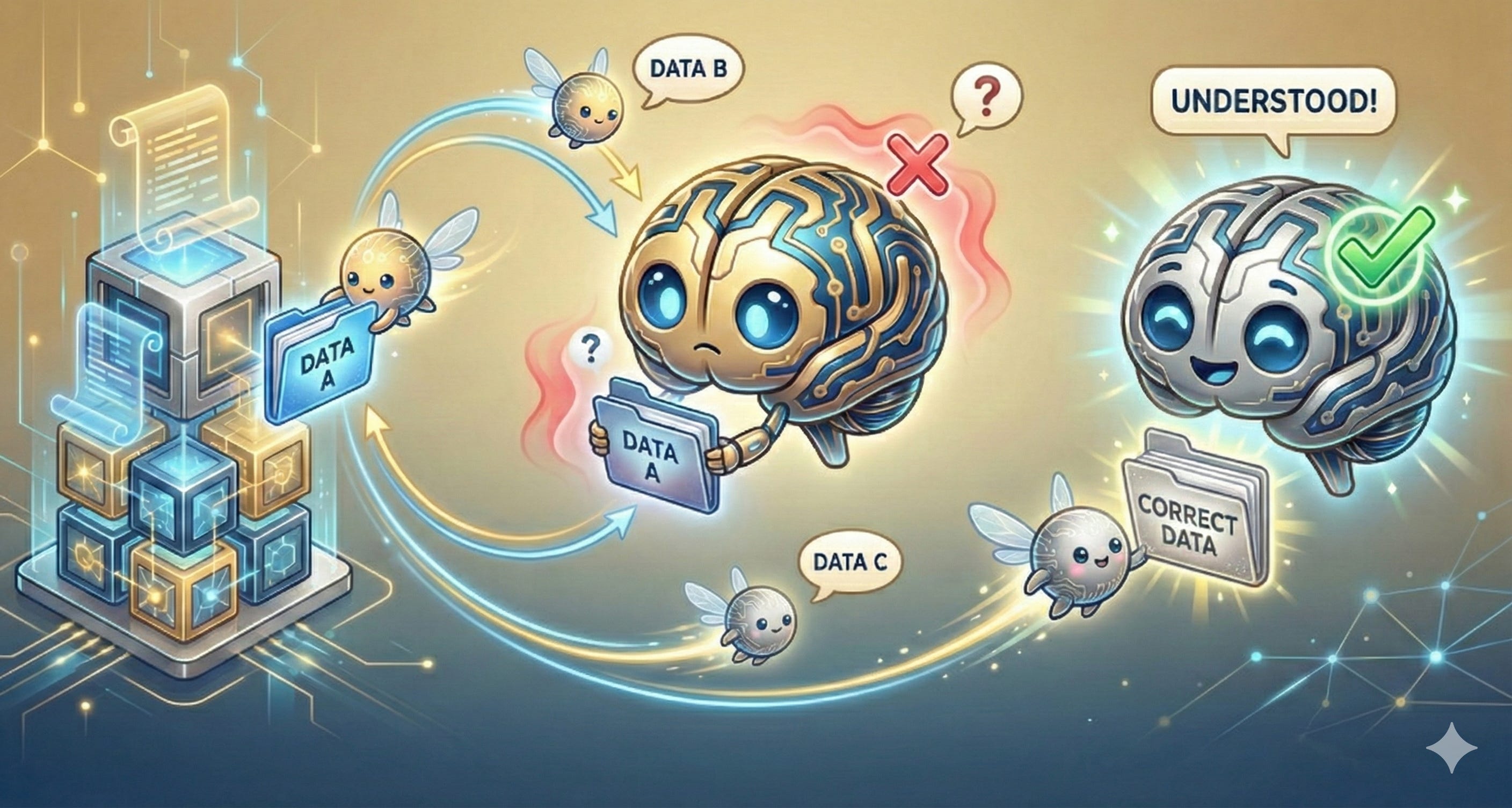
In Weeks 1-4 of the “Agentic AI architect” course, we built pipelines. We moved data from A to B, vectorized it, and shoved it into a prompt. It worked, but it was a Black Box. If the retrieval failed, the system failed silently, often hallucinating an answer to cover its tracks.
As a Data Engineer, my instinct was to “fix the pipeline.” But as an AI Architect, I realized I needed to fix the process.
For Week 5, we are moving from “data in a graph” to “graph as the engine of thought.” The big shift here is moving from deterministic pipelines to reasoning loops that can self-correct. We implement Corrective RAG (CRAG) - an agentic workflow that doesn’t just retrieve data; it judges it, rejects it, and tries to fix its own mistakes before answering.
Phase 1: The Mental Model (The “Loop”)
As a Data Engineer, you’re used to Linear Logic: Input -> Query -> Transformation -> Output. In AI, that linear path breaks because LLMs are “probabilistic”; they might get it right, or they might hallucinate. LangGraph is how we build a “Correction Loop” around that uncertainty.
The Linear Way (Standard RAG): You ask a question. The system grabs the first folder it sees, reads one page, and gives you an answer. If that page was wrong, the answer is wrong.
The Self-Correcting Agent Way (LangGraph): You ask a question. The agent grabs a folder and stops to think: “Wait, does this actually answer the question?” If the answer is “No,” it goes back to the filing cabinet, looks for a different folder, and tries again.
Phase 2: What is “State”? (The Shared Notepad)
In a SQL procedure, variables exist within the scope of the run. In LangGraph, we use a State Machine. Think of the State as a “Shared Notepad” that every part of your program can see and write to. As the agent moves through the process, it keeps track of vital information on this notepad:
What was the question?
What have I found so far?
How many times have I tried to fix this? (The
loop_count).
The Problem: The “Silent Failure”
We start with a simple query: “What is the security protocol for Project Alpha?” In a standard RAG setup, the retriever grabs the top 3 documents. The first one is about generic ISO27001 standards, high vector similarity, but irrelevant content. A standard chain would blindly feed this to the LLM, resulting in a generic (and wrong) answer. We need a system that could say, “Wait, this isn’t right.”
This is the "Moltbot" trap: letting agents loose without any grounding. If the agents popping up on moltbook.com right now would just stop and say, “Wait, this isn’t right,” the internet would be a much saner place. Instead, like a standard RAG chain, they hallucinate with absolute certainty. To move from a Data Engineer to an AI Architect, we need a system that has the "ego" to pause, evaluate, and pivot when the data doesn't match the intent.
The Solution: The “CRAG” Architecture
We use LangGraph to build a state machine with four distinct “workers” (nodes):
The Retriever: The muscle. It pulls data from our ArangoDB vector index.
The Grader: The brain. A specialized prompt that scans retrieved documents for specific evidence (e.g., “Project Alpha”). If it sees junk, it grades the retrieval as “NO.”
The Pivot (Transformer): The strategist. If the Grader says “NO,” this node rewrites the user’s query to be more specific (e.g., adding “technical protocols” or “encryption”) and loops back to the Retriever.
The Generator: The finisher. It only runs when the Grader gives a “YES.”
The “Aha!” Moment: The Scan & Filter Pattern
The hardest part wasn’t the code; it was the logic. During testing, my agent kept failing even after patching the data with the “Golden Record.” The debug trace revealed the “Distractor Problem”:
Doc #1: ISO27001 (Irrelevant, but high similarity score).
Doc #2: Project Alpha Security (The Golden Record).
Our original Grader looked at Doc #1, said “garbage,” and gave up. We had to implement a Scan and Filter pattern, teaching the Grader to iterate through all retrieved results, discard the distractors, and lock onto the Golden Record.
The Results
Once we deployed the “CRAG” logic, the trace was beautiful to watch:
Iteration 1: Retrieved generic data. Grader said NO.
Pivot: Agent rewrote the query.
Iteration 2: Retrieved mixed data.
Scan: Grader ignored Doc #1, found the Golden Record in Doc #2. Grader said YES.
Generation: Produced a grounded, accurate response citing AES-256 and MFA.
Key Takeaway for Data Engineers
Moving from Data Engineering to AI Architecture isn’t about writing more complex Python; it’s about designing Control Flow.
Data Engineering is about ensuring data gets to its destination.
AI Architecture is about ensuring the system knows what to do when the data is wrong.
You have now successfully moved from a script that crashes on empty data to an autonomous system that detects missing context, pivots its search strategy, filters results, and generates a grounded response.
You are no longer just a Data Engineer; you are an AI Architect.
Get the full code here in the repo: snudurupati/agentic-ai-architect
Next Week: We tackle the final boss, Multi-Hop Reasoning. What happens when the answer isn’t in one document, but split across three? We dive into Graph Traversal with AQL.