

A Data Engineer’s perspective on how to make sense of all the AI Noise.
Last week, I attended the dbt Coalesce summit, where I served as booth duty and spoke with attendees, explaining how AI agents can help data engineers increase productivity, reduce their cloud data warehouse spend, and enhance data quality throughout the data stack. There was a recurring theme, a recurring question: my CDW, my DE tool, and my orchestrator all individually have built-in copilots, so what’s the need for yet another AI layer? While I am still pondering an answer to that question, another different but relevant question popped into my mind: What’s up with all these acquisitions by all these data and analytics companies lately?
Lots of Noise, One real Signal.
In the past few months, I have been closely following all of Databricks’ acquisitions and partnerships alone. First, they agreed to acquire Neon, the company behind serverless PostgreSQL, and the reason given was to enhance AI agent-building capabilities. Like most data engineers who haven’t fully bought into the Agentic AI hype yet, I wrote it off as Databricks just trying to eliminate the data ingestion middleware like Fivetran and Matillion and get the freshest data straight from the source; this idea was reinforced by their partnership with SAP that came later. However, the acquisition of Mooncake Labs and now their partnership with Cognite and OpenAI, they all seem to be really playing into their Lakebase + Agent Bricks strategy.
So when I try to isolate a signal from all the AI noise, it is clear that Databricks expects AI beyond just copilots and analytics; they are heavily betting on AI Apps as first-class citizens of the data analytics ecosystem.
Now let’s try to unpack what first-class AI Apps look and feel like from a Data Engineer’s perspective.
AI Apps: The Art of the Possible
AI Apps as first-class analytics citizens means treating AI apps as core data products and not as side priorities. In my limited data engineering world-view and based on what I have researched so far, first-class AI apps could mean multimodal applications that can simultaneously process multiple types of data like voice, text, medical diagnostics, images, and radar data. Some applications of multimodal AI apps could be in the healthcare field where AI analyzes information from diverse sources like clinical notes, medical images, and other documents and generates a personalized patient treatment plan.
AI Apps could be also be AI agents that can autonomously build and maintain workflows. As data engineers, the latter is of more curiosity to us, and some possibilities of such first-class AI Apps could be:
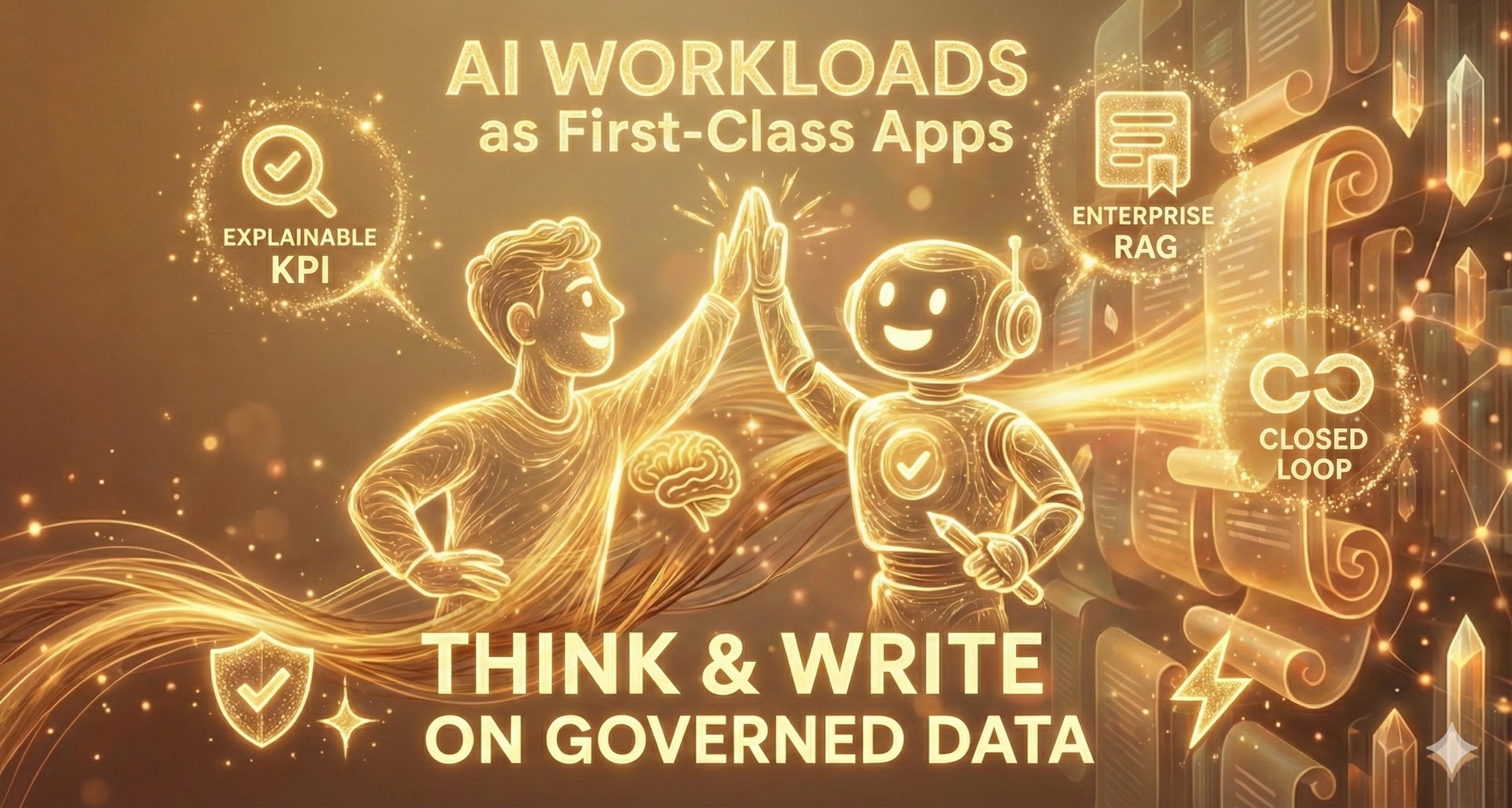
Explainable KPI Copilot – A natural language interface that answers questions like “why did profit dip last quarter despite an increase in total revenue” and proves the answer with lineage, SQL, and provides row-level drilldowns. It always backs up every generated metric with traceable data.
Closed-loop metrics improvement – A natural language analyst that proposes experiments for a specific metric, ships a feature flag, observes that metric, and proposes the next iteration with guardrails.
Enterprise RAG with existing Data Warehouse – A governed retrieval and generation service that answers business questions using your data warehouse as the system of record, with citations, lineage, and write-backs, and SLOs like any other app. This solves the problem of business stakeholders wanting to ask natural language questions that they can trust and verify.
While AI apps as first-class citizens are absolutely possible, there are risks that can bring enterprise adoption to a standstill.
Why AI Adoption Stalls
The fastest way to stall AI adoption is to ship a shiny agent with no audit trail. When messy stuff starts showing up, when the AI agent reads some PII data that it isn’t supposed to, a KPI number can’t be reproduced or traced back to the source, or a friendly agent updates a record or opens a ticket without the right permissions. When decision-making is a black box, with no transparency into what query ran, what docs were read, or who approved the scope. Thats when trust in the agent fades, audit teams step in, leadership loses confidence in AI, and we’re back to manual reviews.
What good looks like
Good means every agentic answer and action is traceable. Every KPI links straight to the underlying table, the owner, and the version. Agentic AI apps only run with purpose, bound credentials, narrow tool scopes, and use short-lived sessions. Reproducing a result needs to be made boring, replaying the same prompts, tool calls, and SQL with the same inputs. Safety checks aren’t bolted on; they run before execution, and anything risky gets routed to a human.
For executives, there’s a single page that shows where agents are deployed, what data they can touch, what broke last week, and what business results they delivered.
We need to build apps that both think and write, on governed data, with real SLOs. The teams that make low-latency state, evaluation, and guardrails boringly reliable will cut through the hype, and then AI starts paying dividends.