

Design your permissions, don’t live on defaults.
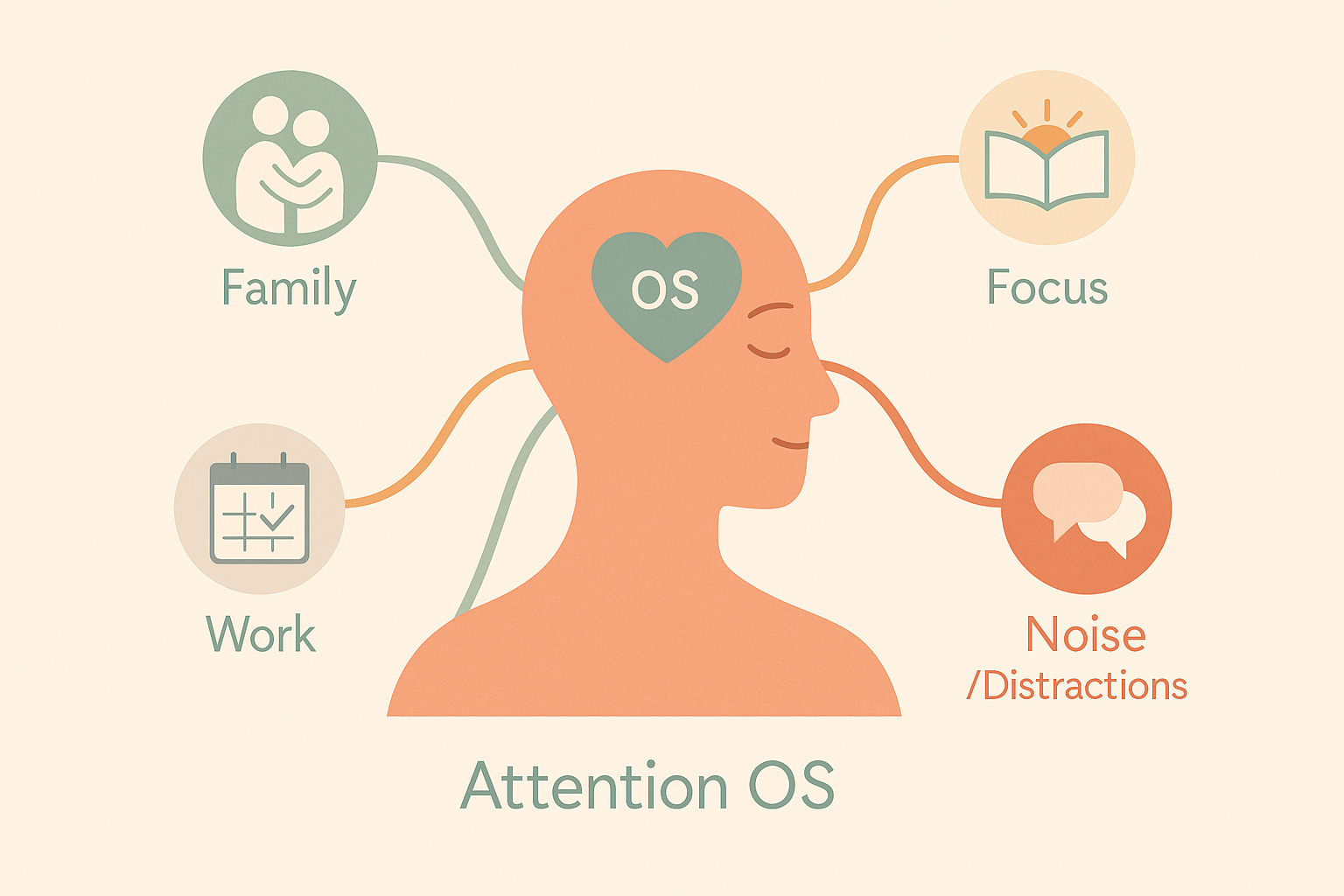
Thesis
“The ability to choose how I spend my time and mental bandwidth is my operating system”
When I run processes outside that design, like taking on consistent late evening work obligations, fragmented evenings, constant context switches, everything else malfunctions.
Personal Defaults
I’m a morning person. Always have been. My best rest and recovery are 10 pm-4 am, and my sharpest work is before dawn. When I ignore that and let after-hours obligations preempt sleep and spill into family time, the costs show up fast: forgetful in meetings, short with my 4-year-old’s bedtime routine, reading less, caring less. That’s on me for leaving my scheduler open.
“The ability to choose how I spend my time and my mental bandwidth is not a luxury for me, it’s my operating system. When stripped away, everything else malfunctions.”
What an OS Does
Autonomy over my attention and energy is my fundamental architecture, not a feature, the underlying platform on which everything else runs on. This metaphor highlights sovereignty. An operating system controls resource allocation, determines what processes get priority, manages what runs in the background. If that’s truly not mine to control, then I am not really running my own OS but running someone else’s software on my hardware.
This perspective also clarifies the current environment that we live in. We are surrounded by entities, platforms, employers, cultural expectations that want to install themselves as our OS or at least run a persistent background process. Treating our attentional autonomy as foundational rather than negotiable is a necessary defense against this age of massive distractions.
Interdependence, By Consent
The tension I see is that we are interdependent beings. Some of the most meaningful things in life: relationships, kids, commitments, care; involve voluntarily granting access to our attention and letting them make legitimate claims on our time and mental bandwidth. That’s not a drain; it’s wholesome and dopamine-replenishing. The question is, are you choosing which permissions to grant or has your system been rooted without your consent?
Here’s the uncomfortable bit: if something can schedule over my sleep, preempt my focus, and seize my attention on demand, that’s not “hustle”, that’s root-level access I failed to manage. It snuck in as “one quick late call,” then installed updates, then rewrote my defaults. If my mind’s scheduler isn’t mine, I’m not free; I’m just highly managed by defaults I didn’t design.
Interdependence doesn’t contradict sovereignty. My kid’s bedtime gets whitelisted access. Reading “just one more book” at 9 pm isn’t a drain; it’s a trusted process that returns energy. Same with relationships, real care, real commitments, they get explicit permissions, not a blank SSH key to my brain. The difference is consent, clarity, and kill-switches.
Why This Matters Beyond Calendar Ethics
Multitasking is the human version of “just add more context.” It feels powerful but it’s not. My head isn’t a data lake; it’s closer to an L2 cache. Push too much through it and you pay in cache misses, and heat. Every late meeting was an interrupt that blew away useful state. I’d show up foggier the next morning, then compensate by stacking more tasks, then miss details, then open more tabs. That loop looks productive from the outside but is a leak from the inside.
If an LLM analogy helps: models “hallucinate” because they must keep predicting even when the prompt is noisy or the facts aren’t there. Humans “hallucinate” under multitasking because we keep acting while our working memory is shredded and half of our attention is stuck on the last thing. Different mechanisms, same shape of failure: too many tokens, too little signal.
Running My Own OS
I’m not optimizing for output anymore; I’m optimizing for throughput with integrity. That means less context stuffed into my day, fewer parallel threads, and more deliberate retrieval of what I need right now. I’m keeping the early mornings and the bedtime stories. And I’m uninstalling anything that thinks it owns my scheduler. Control over my attention isn’t a perk, it is the platform. This isn’t a perfect playbook; it’s me debugging my life in production. What’s your operating system and are you the one running it?